
A Legacy Forged in Speed and Vision
Behind every legendary car brand lies a figure whose influence reshapes not only the machines, but the culture surrounding them. For McLaren, that figure was Mansour Ojjeh. More than a financier, he was a visionary—a Franco-Saudi entrepreneur whose passion for engineering and design transformed McLaren from a formidable racing team into a name synonymous with cutting-edge automotive artistry. His involvement with TAG (Techniques d’Avant Garde) culminated in one of the most significant partnerships in Formula 1 history. In 1984, when he backed the team with both capital and conviction, McLaren entered a golden era that would redefine the sport.
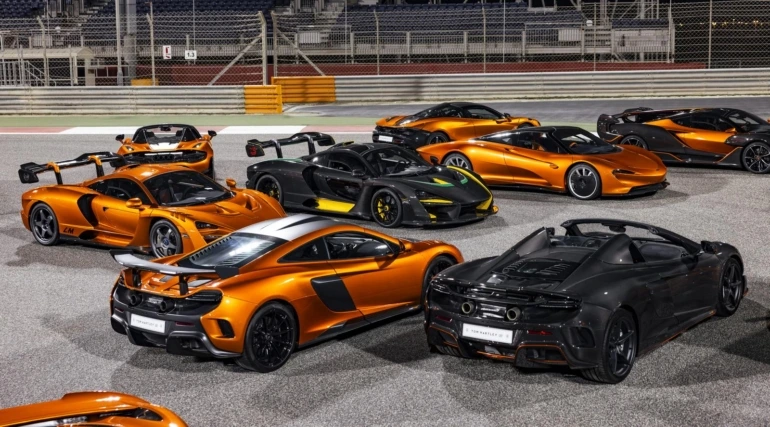
Ojjeh’s support birthed the era of the TAG-Porsche turbo engines, propelling McLaren to new heights across the 1980s and beyond. His influence extended beyond business deals and balance sheets; he was deeply involved in the development of technologies that pushed performance to the edge of possibility. Under his stewardship, McLaren captured seven Constructors’ Championships and ten Drivers’ Championships. But it was his instinct for innovation and reverence for precision that most clearly shaped the company’s evolution—and that sensibility now finds its most vivid expression in the 20 McLaren road cars he personally curated.
Now, with Ojjeh’s passing, this remarkable collection is poised to enter a new chapter. Valued at over $70 million, it’s more than a gathering of rare automobiles—it’s a living record of McLaren’s design evolution, viewed through the eyes of someone who helped define it. Each car represents the final chassis number in its model series, a detail that reveals not just exclusivity, but a collector’s intimate understanding of engineering nuance. These are not just cars; they are precision-cast memoirs of a man and a marque, forged in carbon fiber and devotion.
A Collection Unmatched in Provenance and Perfection
To call the Ojjeh collection rare would be to undersell its singularity. Every model in the fleet was handpicked, and nearly all have remained untouched since delivery—maintained under a bespoke white-glove service agreement directly with McLaren. This level of preservation is virtually unheard of in the supercar world. Aside from the F1, which has a modest 1,810 kilometers on its odometer, and a P1 GTR occasionally exercised on track days, these cars remain in showroom condition. They’ve been stored in a controlled environment, serviced with fastidious regularity, and treated not as possessions, but as part of a living archive.

At the center of this collection stands the mythic McLaren F1 chassis 075—the last of its kind ever built. It’s finished in a color that became synonymous with Ojjeh himself: a luminous, metallic shade known first as Yquem, and later renamed Mansour Orange in his honor. The livery threads through the entire collection, turning each car into a page in a broader design narrative. The exclusivity of the hue, unavailable to any other McLaren owner, gives each vehicle the aura of a bespoke commission—intensely personal, and yet reflective of McLaren’s broader legacy.
Included in the ensemble are icons from every chapter of the brand’s modern era: the Speedtail, Senna, Elva, and the elusive Sabre hypercar—of which only 16 were ever made, and only for the American market. Taken as a whole, the collection forms a complete sentence in the language of McLaren design, spoken through the rarest and most evolved examples of each nameplate. It is a narrative of innovation, performance, and aesthetic discipline that few collections can approach, let alone equal.
Preserving a Monument to Automotive History
Handling the sale is Tom Hartley Jnr, a name known to collectors and institutions for his deft stewardship of high-value automotive estates—including Bernie Ecclestone’s $600 million Formula 1 archive. In his hands, the sale is expected to command not just a premium price, but a considered legacy. The Ojjeh family’s intention is clear: to find a buyer who will preserve the collection as a whole, rather than dispersing its parts across private garages and showrooms. It’s an act of fidelity to Mansour’s vision—a desire to see the ensemble endure as a singular tribute to a life intertwined with speed, precision, and purpose.
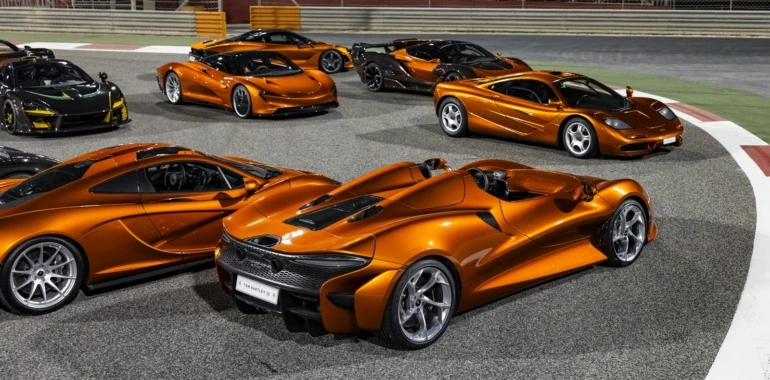
The task is both monumental and deeply personal. Selling a collection of this magnitude is not simply a matter of valuation; it’s about curation, stewardship, and cultural preservation. Each car carries the fingerprint of Ojjeh’s taste—his demand for the final, most refined version of each vehicle reflects a philosophy that excellence is not merely about acquisition, but about completion. To fragment the set would be to dilute a narrative painstakingly assembled over decades.
As the world watches, the sale of Mansour Ojjeh’s McLaren collection is poised to become one of the most consequential automotive events of the decade. It is a moment that bridges private passion and public history—a chance to celebrate not just the machines, but the man who helped build the world in which they could exist. For collectors, it is the rarest of opportunities: to step not into the driver’s seat, but into a legacy.