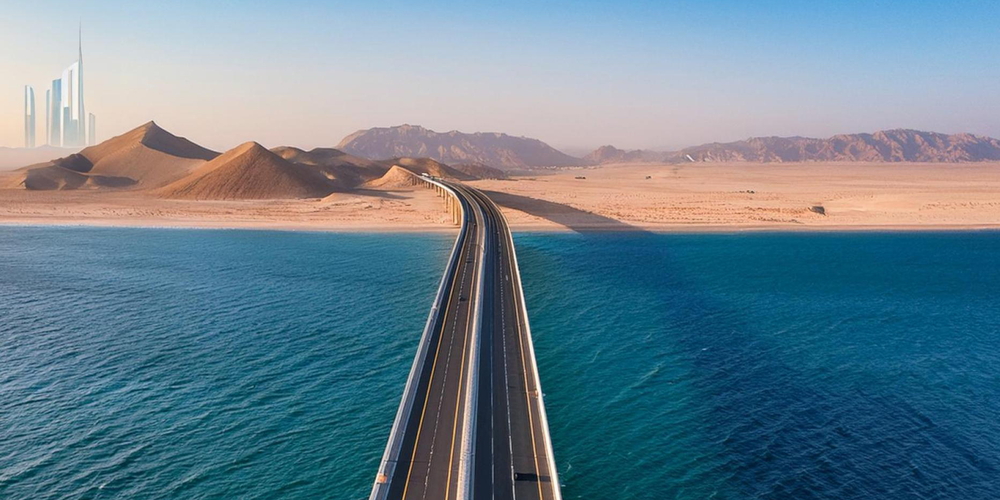
Continental Connection Forged in Steel and Ambition
In a region defined by both ancient trade routes and modern ambition, Saudi Crown Prince Mohammed bin Salman is set to redraw the map—literally. His proposed Red Sea Bridge, stretching 32 kilometers across one of the world’s most storied bodies of water, aims to link Ras Al Sheikh Hamid in Saudi Arabia to Egypt’s resort hub, Sharm el-Sheikh. With a projected budget of $4 billion, the bridge—unofficially referred to as the “Moses Bridge”—promises to become not just a feat of engineering, but a symbol of regional convergence and economic alignment.
Now in its advanced planning phase, the structure will be the first of its kind across the Red Sea, carving a direct land connection between the Arabian Peninsula and the African continent. On the Saudi side, the bridge will merge seamlessly into NEOM, the kingdom’s $500 billion urban megaproject meant to redefine sustainability, technology, and living standards. To the west, it will tie into Egypt’s road network, linking with the New Administrative Capital that’s emerging as Cairo’s modern counterweight. The project doesn’t simply span water—it links ideologies, economies, and futures.

The vision is deeply tied to Saudi Arabia’s broader transformation under Vision 2030, a plan that seeks to diversify the kingdom’s economy and expand its global cultural presence. The Red Sea Bridge embodies that mission with clarity, transforming what was once a maritime border into a terrestrial artery. In this context, the bridge is not just infrastructure—it is an instrument of diplomacy, trade, and shared prosperity between two of the Arab world’s most influential nations.
From Coastal Myths to Concrete Realities
The moniker “Moses Bridge” carries poetic weight in a region steeped in religious and historical symbolism. Tiran Island, which the span will pass over, is believed by some to lie along the biblical path of the Exodus. But while the name invokes the past, the structure’s promise is grounded firmly in the future. When completed, the bridge will turn what is now a multi-hour ferry journey or flight into a seamless 30-minute drive—an act of geographic and symbolic unification that reflects a new chapter in Arab cooperation.
According to Egyptian Transport Minister Kamel al-Wazir, the final decision on whether the crossing will be a bridge or a tunnel remains under discussion. However, both nations have expressed readiness to begin implementation, underscoring the project’s urgency and shared political will. Egypt, keen to channel more tourism into Sinai and its expanding capital projects, views the bridge as a catalyst. For Saudi Arabia, it’s a key piece in activating NEOM’s tourism corridor, connecting it to well-established Egyptian resorts and giving substance to the desert city’s global ambitions.
Tourism is only part of the larger equation. Analysts believe the corridor could vastly expand bilateral trade and logistics efficiency, further integrating the economies of Egypt and Saudi Arabia. By improving accessibility and shortening supply routes, the bridge may also bolster energy collaboration, labor mobility, and joint ventures across sectors. In this light, the bridge is more than a tourist route; it’s a strategic linchpin in a broader vision of cross-border synergy and regional autonomy.
Designing a Gateway to Tomorrow
Architecturally, the bridge will need to negotiate not just the natural conditions of the Red Sea but the political sensitivities of an ecologically and militarily significant area. Tiran Island, located at the mouth of the Straits of Tiran, has long been a focal point of regional diplomacy, with historical agreements placing it under international oversight. As such, the structure will have to reflect not just engineering finesse, but diplomatic precision. Early reports suggest sustainability will be prioritized in the design, aligning with NEOM’s carbon-neutral ethos and Egypt’s push toward greener infrastructure.
Beyond the practical, the design is expected to serve as a cultural gesture—an emblem of Arab unity and forward momentum. While official renderings have yet to be released, architectural commentators speculate that the bridge may incorporate traditional Middle Eastern motifs into a futuristic framework, reflecting the dual identities both NEOM and Egypt’s New Administrative Capital are attempting to balance. The project is not just about passage, but presentation—what it means to arrive, to depart, and to connect.
In a world increasingly divided by borders, the Red Sea Bridge offers a rare inversion of that trend: a new route created to bring cultures and economies closer. As Saudi Arabia and Egypt continue to redefine themselves on the global stage, this crossing may well stand as a landmark of shared ambition—proof that in the architecture of the future, progress is measured not just in steel and kilometers, but in the promise of what can be built together.