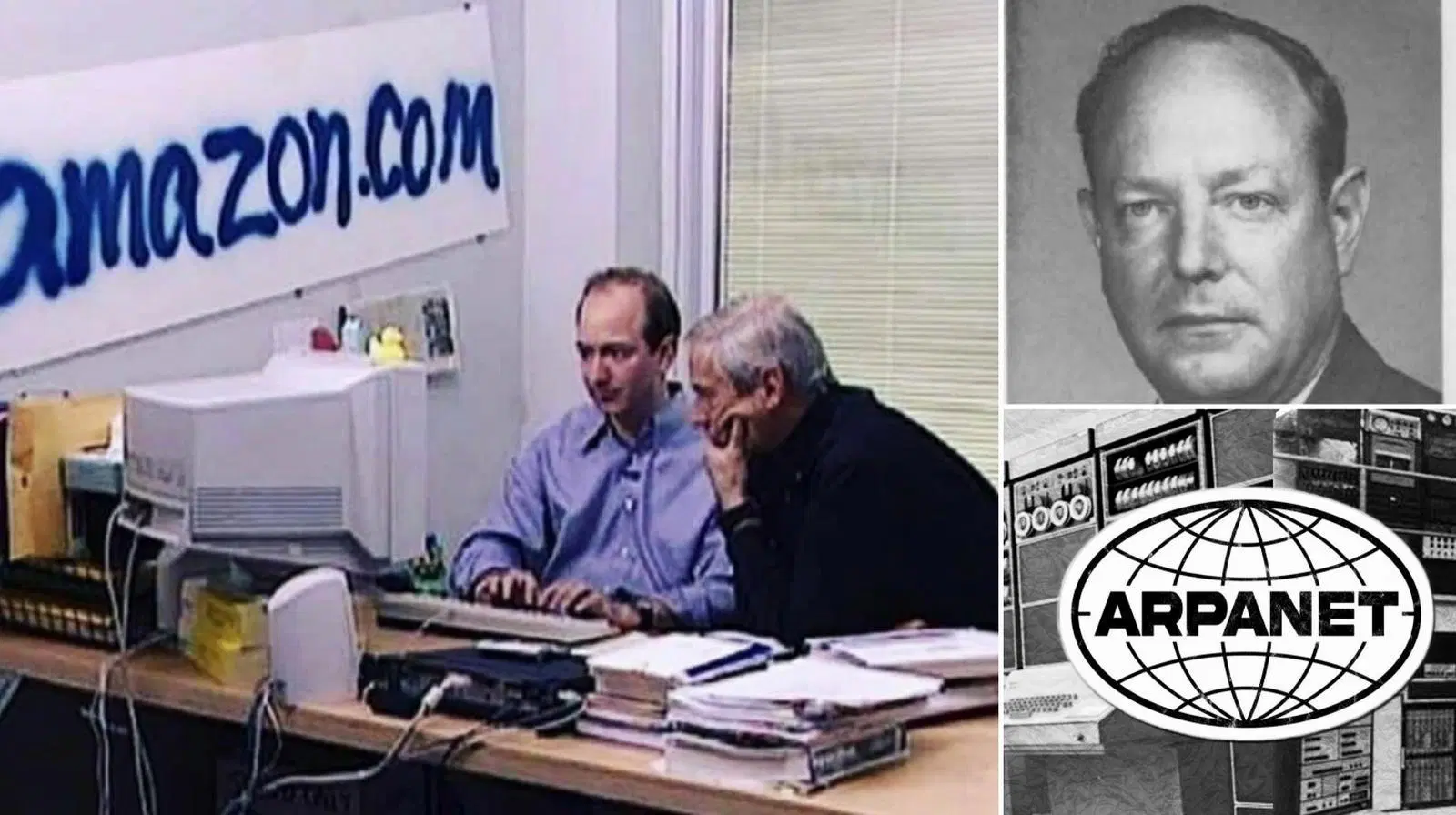
The Quiet Architect Behind ARPA
The story of Amazon often begins with Jeff Bezos in a Seattle garage in 1994, but its true roots stretch further back to Washington, D.C. in the late 1950s and to a man known within his family simply as “Pop.” Lawrence Preston Gise, Bezos’ maternal grandfather, was among the technocrats who built the foundation for the Defense Department’s Advanced Research Projects Agency (ARPA). Established in February 1958 in the aftermath of Sputnik, ARPA was created to reassert American scientific leadership, and its work would ultimately give birth to the internet itself. While the engineers and scientists who drove its breakthroughs often capture the spotlight, it was administrators like Gise who quietly set the agency on stable footing.
Pop’s role was not glamorous, but it was pivotal. Within months of ARPA’s creation, records show him serving as Director of Program Control and Administration, one of the agency’s first leadership positions. By 1959, CIA documents listed him as Assistant Director for Administration, the man responsible for ensuring bold ideas could move from concept to contract. Gise built the systems of accountability including budgets, reporting mechanisms, and contracting processes that allowed ARPA’s scientists to operate with unusual freedom. In effect, he created the scaffolding upon which innovation could climb.
One of his most important contributions was overseeing the development of the “ARPA Order,” a streamlined contracting tool that bypassed the bureaucracy typical of defense procurement. This mechanism gave researchers flexibility to act quickly and explore untested ideas in satellites, computer science, or early networking experiments. Without such administrative innovation, the daring technical achievements of ARPA might never have had room to flourish. Though his name rarely appears in the histories of the internet, Lawrence Gise’s imprint is indelibly present in the systems that made it possible.
The Texas Ranch and a Grandson’s Lessons
Away from Washington’s corridors of power, Gise found solace on his family’s ranch near Cotulla, Texas, known as the “Lazy G.” It was here that his grandson, Jeff Bezos, spent his childhood summers. Far from the machinery of government, Bezos was immersed in a world that valued resourcefulness, discipline, and patience. Chores were non-negotiable. If a windmill broke or a fence needed repair, the lesson was not to call for outside help but to solve the problem with what was available. It was a formative training ground in self-reliance.
Jeff has often described his grandparents as his most important role models, saying he “worshipped” them during his youth. Pop, in particular, embodied a quiet competence that was steady, analytical, and unflappable. The young Bezos observed not just his grandfather’s ability to manage complexity at the Pentagon but also his ability to manage land, animals, and machinery in the rugged Texas environment. That duality of bureaucratic precision in Washington and practical problem-solving on the ranch instilled in Jeff a worldview that blended long-term systems thinking with everyday ingenuity.
The ranch also gave him time to dream. Isolated from the distractions of city life, Jeff would spend hours tinkering, reading, and imagining. The rhythm of rural life provided the space for curiosity to expand, while Pop’s example provided the model of how to turn ideas into durable systems. In hindsight, it was the perfect apprenticeship: one man quietly shaping the machinery of government in the mid-20th century, and his grandson learning how to build machinery of a very different kind in the century to come.
From ARPA to Amazon: Legacies of Scale
When Bezos founded Amazon in 1994, the initial idea of selling books online seemed niche, even eccentric. But over three decades, that experiment evolved into a global platform that has permanently altered commerce. By 2024, Amazon accounted for roughly 40 percent of U.S. e-commerce, a scale that places it not merely as a company but as the infrastructure of online shopping. The simple act of clicking “Buy Now” owes its seamlessness in part to Amazon’s patented 1-Click checkout, a feature so influential that Apple licensed it for its own platforms.
Beyond consumer convenience, Bezos built Amazon as a marketplace as well as a retailer. Today, over 60 percent of sales on the site come from independent sellers, making Amazon the backbone of countless small businesses worldwide. Just as ARPA created systems for scientists to innovate, Amazon created systems for entrepreneurs to reach customers, offering logistics, distribution, and digital storefronts at a scale that would otherwise be impossible. Both innovations share a common DNA: empowering others to build atop the platforms that were designed for them.
The parallel between grandfather and grandson is striking. Lawrence Gise worked in the shadows, ensuring visionary projects had the administrative freedom to thrive. Jeff Bezos operated in the spotlight, ensuring consumers had the technological ease to buy. One built frameworks inside the Pentagon, the other built a global marketplace from a garage. Together, separated by time but united by approach, they illustrate how systems in both government and commerce can reshape the way the world connects, communicates, and consumes.