A Seafaring Vision on Solid Ground
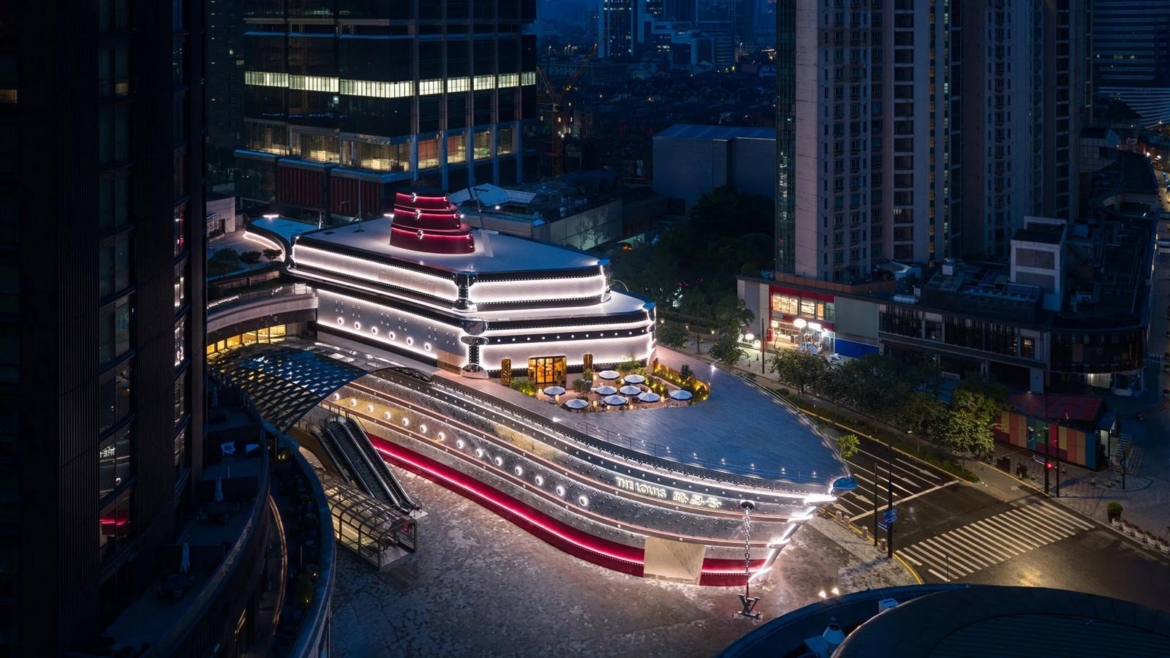
In a city known for architectural bravado and commercial innovation, Louis Vuitton has managed to do something truly unexpected: dock a full-scale cruise ship in the heart of Shanghai. Located on the bustling Nanjing West Road in the Taikoo Hui complex, The Louis—as the boutique is officially called—reimagines the brand’s storied connection to travel through a bold, ship-shaped flagship that feels more like a cinematic set piece than a retail environment. The brand’s signature monogram, historically stamped onto luggage bound for grand tours and ocean liners, now decorates an actual vessel, permanently anchored in one of China’s most cosmopolitan retail districts.
Spanning 13,000 square feet across three immersive floors, the boutique pays homage to Louis Vuitton’s roots in travel—an identity shaped in the 19th century with the creation of iconic hard-sided trunks. From the outside, The Louis is a marvel of detail: the upper cabin appears to be assembled from stacked travel trunks, while the hull curves outward with the maison’s famed canvas motif. It’s a building meant to stop foot traffic, but also to celebrate the poetic transformation of utility into luxury—a tradition Vuitton has long perfected.
Inside, visitors enter a world curated to inspire both awe and intimacy. Ten themed rooms unfurl like chapters in a global voyage, offering everything from classic leather goods to contemporary ready-to-wear collections. Each space feels distinct yet cohesive, linked by maritime references and custom design elements that echo the refined interiors of luxury ships. If Louis Vuitton ever wanted to transform its heritage into an architectural metaphor, this is it—an anchored vessel that never leaves port, yet promises endless journeys.
History on Display, Experience in Motion
Beyond retail, The Louis doubles as an experiential gallery and cultural archive. At the core of its storytelling is the “Louis Vuitton Extraordinary Journey” exhibition, a carefully curated narrative that traces the maison’s longstanding relationship with maritime travel. It’s a reminder that long before the brand adorned fashion week runways, it was building trunks for steamer crossings and rail-bound voyages—a history that is both romantic and deeply relevant in this age of rediscovered wanderlust. Visitors are invited not only to shop, but to pause and reflect on the meaning of movement itself.
On another level, the boutique offers themed rooms that bring Louis Vuitton’s cultural and lifestyle universe to life. A Perfume Room features archival toiletry kits and fragrances that once traveled the globe in private compartments. The Book Room displays rare works from Gaston-Louis Vuitton, an avid collector and writer whose literary interests helped shape the maison’s aesthetic sensibility. A Sports Room highlights Vuitton’s modern-day collaborations, including gear made for elite competitions like Formula 1 and the Olympic Games. These spaces collectively suggest that Louis Vuitton is less a fashion brand than a curator of global experiences.
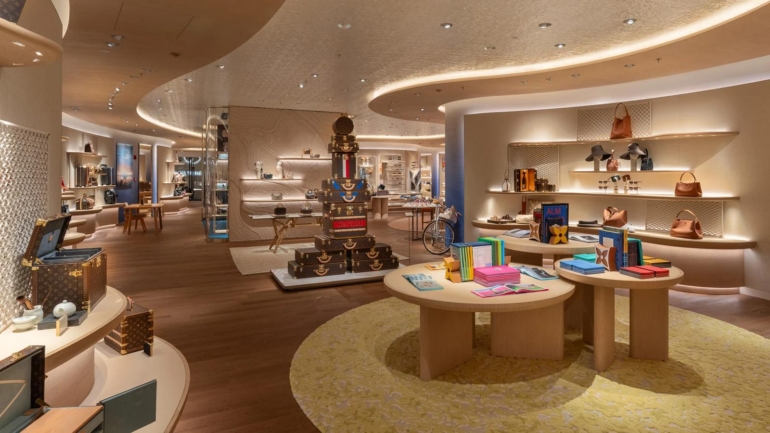
At the ship’s foredeck sits Le Café Louis Vuitton, a culinary destination as considered as the merchandise that surrounds it. Designed with minimalist elegance and warm wood accents, the café merges Shanghai flavors with European influences—dishes like scallion-oil poached langoustines meet madeleines and espresso with Parisian flair. For visitors, it’s both a pause and a punctuation mark: the final stop on a journey that begins with craftsmanship and ends in comfort.
A Global Maison With Floating Dreams
This isn’t Louis Vuitton’s first foray into architectural experimentation. At Marina Bay Sands in Singapore, the brand debuted The Island Maison, a jewel-like floating boutique made entirely of glass and steel. Linked to shore by an underwater tunnel, the pavilion captures the imagination with its surreal setting and modernist structure. And in Chengdu, China, Vuitton transformed its Tiger Tail Maison into a living sculpture—threading a colossal tiger tail through the facade, across the courtyard, and into the store itself, creating a dynamic visual narrative that blurred the lines between fashion and fine art.
What distinguishes The Louis in Shanghai, however, is the intimacy of its metaphor. A cruise ship is not just a mode of travel—it’s a floating world, a self-contained environment where luxury, leisure, and discovery converge. By bringing this form ashore, Louis Vuitton speaks to a generation of consumers who value experience as much as exclusivity. It invites them aboard not for a voyage, but for a transformation—each visit, a ticket to somewhere new, even if only metaphorically.
The brand’s president of Greater China, Wu Yue, echoed this sentiment in a statement, noting that the ship-shaped boutique “echoes Shanghai’s urban spirit of embracing all rivers and seas” while also projecting an “international outlook of innovation and forward momentum.” It’s a poetic alignment between the city’s aspirational identity and Vuitton’s own evolution from a trunk-maker to a global tastemaker—both in design and cultural cachet.
In a retail landscape increasingly driven by e-commerce and ephemeral trends, Louis Vuitton’s ship in Shanghai is a bold act of permanence. It anchors a narrative of craftsmanship, elegance, and imagination—and does so in a language that feels as familiar as it is forward-thinking. Not every flagship is built to last, let alone to inspire. But this one? It was made to sail into memory.