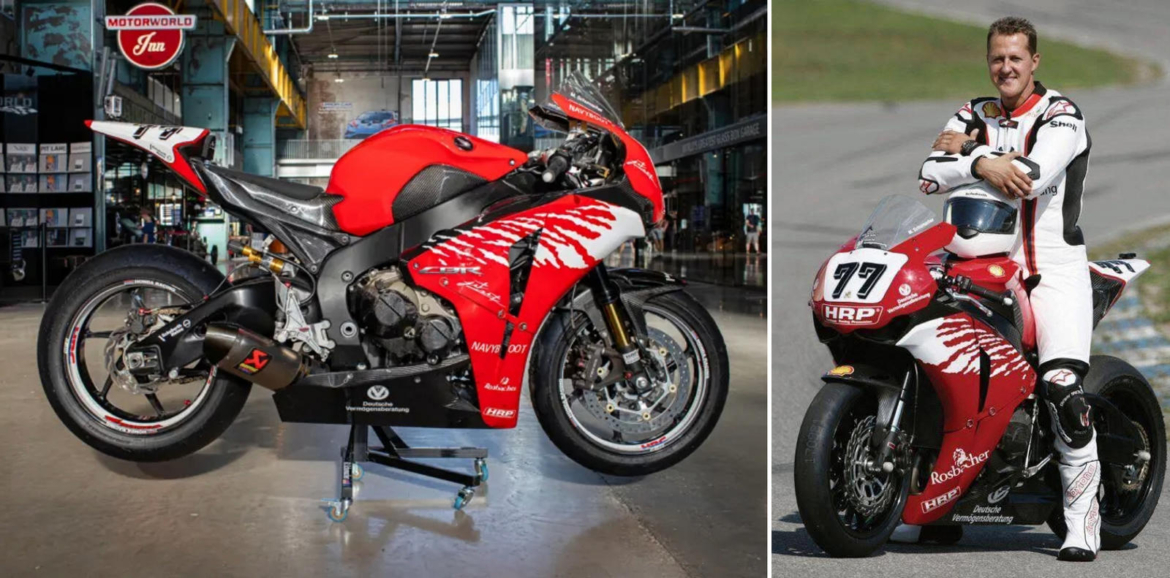
A Champion in Transition, Not in Retreat
For most, Michael Schumacher is forever etched in memory as the Formula 1 titan—a figure of laser focus and calculated aggression, winning seven world championships and forever altering the shape of modern motorsport. But when he stepped away from Formula 1 at the end of 2006, he didn’t settle into a life of quiet luxury or leisurely detachment. Instead, the man who had conquered the pinnacle of four-wheel racing redirected his energy and discipline toward something more visceral, more raw: competitive motorcycling.
Between 2007 and 2009, Schumacher took part in Germany’s IDM Superbike Championship, often racing under the radar but never without impact. Onlookers were consistently impressed by his speed and technique, culminating in a memorable podium finish at the Pannónia-Ring in Hungary. His appearance on the grid wasn’t a novelty or PR stunt—it was the continuation of a career defined by velocity, precision, and the sheer will to compete, regardless of the discipline.
That relentless pursuit of speed led to the creation of a machine designed not for spectacle but for performance. During his years on two wheels, Schumacher collaborated with Holzhauer Racing Performance—a respected German tuning outfit—to build a bespoke superbike tailored to his exacting standards. The result wasn’t just another bike. It was a statement: a two-wheeled extension of Schumacher’s competitive ethos.
A Motorcycle Built for a Master of Speed
The machine in question is a 2010 Honda CBR1000RR Fireblade, now offered at RM Sotheby’s online auction. Far from a stock showroom model, this Fireblade was engineered for one purpose: to meet the demands of a man whose understanding of mechanical feedback bordered on the supernatural. Built by Holzhauer Racing, the motorcycle is equipped with a race ECU, complete with advanced settings for traction and wheelie control—systems that respond with the kind of immediacy and subtlety a seasoned racer expects.
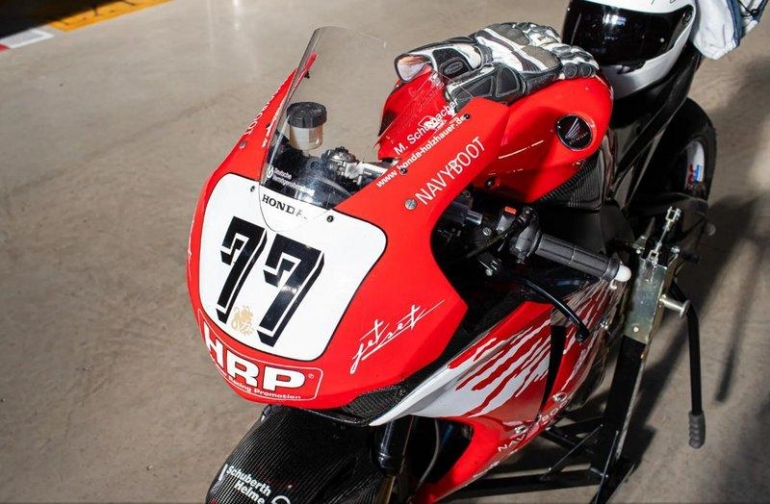
Complementing the electronics is a suite of high-performance components designed for track efficiency and control. A lightweight Akrapovič titanium exhaust system enhances airflow and tone, while a race-spec airbox and upgraded oil cooler contribute to the bike’s thermal efficiency under high-stress conditions. A quick shifter enables seamless gear changes, and the handlebars—replaced with aggressive clip-ons—offer Schumacher the posture and feedback necessary to push his limits. Finished in a custom livery with his number 77, the Fireblade is not merely modified; it is curated.
The bike is presented with a collection of personal effects that root it further in Schumacher’s hands-on history. Included in the lot are a signed Schuberth helmet, a pair of riding gloves, and a custom bike cover bearing both Schumacher’s and Holzhauer’s names. Together, they transform the Fireblade from high-performance machine to personal artifact—a tangible reminder of a sporting icon’s less-public but no less serious passion for racing on two wheels.
More Than Memorabilia: A Legacy in Motion
While the Fireblade stands apart as a functional collectible, it also joins a wider offering of over 280 pieces of Formula 1 memorabilia now crossing the block at RM Sotheby’s. These artifacts—race-worn Ferrari suits, signed helmets, and personal effects from the paddock—compose a layered portrait of motorsport’s most storied era. Among them are Jean Todt’s personal Girard-Perregaux chronograph, Ayrton Senna’s signed boots, and Lewis Hamilton’s race-used Puma gear, creating a veritable museum of speed and legacy for discerning collectors.
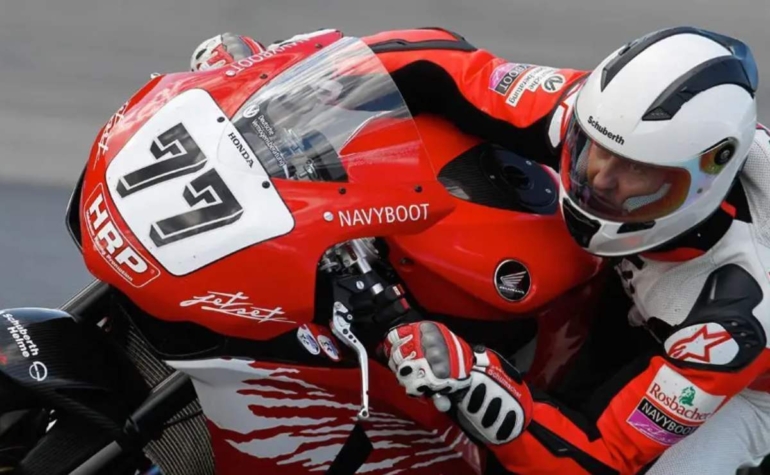
But unlike a helmet locked behind glass or a suit preserved in archival packaging, the Fireblade invites participation. With an estimated value between $30,000 and $42,000 and offered without reserve, it presents a rare opportunity not just to own a piece of motorsport history, but to ride it—to feel the road beneath a machine once fine-tuned for Schumacher’s personal edge. That it remains rideable rather than retired speaks volumes about its intent and the philosophy behind its design.
In a collection full of relics, the Fireblade stands as a working memory—engineered, personalized, and proven. It captures the essence of Schumacher’s relentless drive, not as a champion seeking rest, but as a racer constantly evolving. It is, in the end, a machine born not of nostalgia, but of continued momentum—a fitting emblem for a man whose story has never been static.