
From Edinburgh Cafés to Global Fame
In the early 1990s, J.K. Rowling was far removed from the life of yachts and billion-dollar franchises. Newly divorced and raising her infant daughter Jessica in Edinburgh, she relied on welfare checks that provided roughly $100 a week in support. Housing benefit covered the rent of her modest flat in Leith, a place that was warm but hardly glamorous. Contrary to persistent myths, she has clarified that she did not write in cafés out of poverty alone. She went there because the rhythm of a walk would soothe her baby to sleep, and the hum of conversation gave her the space to write without interruption.

It was in those cafés, balancing exhaustion and determination, that Rowling first sketched the outlines of a story about a boy wizard. But her path to recognition was far from assured. When she completed the manuscript of Harry Potter and the Philosopher’s Stone, it was rejected by a dozen publishers before Bloomsbury finally acquired it in 1997. The deal was modest, with an advance of just $3,200 and an initial print run of 500 copies. Yet it planted the seed of a phenomenon that would soon reshape modern publishing.
That first book became the foundation of the Harry Potter series, which would ultimately sell more than 500 million copies worldwide and inspire a global cultural empire of films, stage productions, theme parks, and merchandise. From one of Britain’s poorest single mothers, Rowling transformed into the world’s first billionaire author. It remains one of the most cited rags-to-riches stories of modern literature.
Life at Sea: From Amphitrite to Samsara
Rowling’s rise also changed the scale of her surroundings. Her first taste of nautical luxury came with Amphitrite, a 156-foot yacht that had once been chartered by actor Johnny Depp. She acquired it for a time before eventually selling it for $19 million, an early introduction to the lifestyle of maritime escape. The vessel reflected a new chapter in her life, one where the burdens of cramped flats and welfare calculations gave way to spaces designed for leisure and retreat.
Today, that early experiment has been eclipsed by Samsara, a 290-foot superyacht built by the Dutch shipyard Oceanco and valued at roughly $150 million. Spanning five expansive decks, the yacht is both palace and sanctuary, costing an estimated $15–20 million annually to maintain. For perspective, its yearly upkeep alone equals many thousands of years of the rent Rowling once struggled to pay in Edinburgh. It is a transformation that underscores the sheer magnitude of her journey, from survival on state benefits to stewardship of one of the most extravagant private vessels afloat.
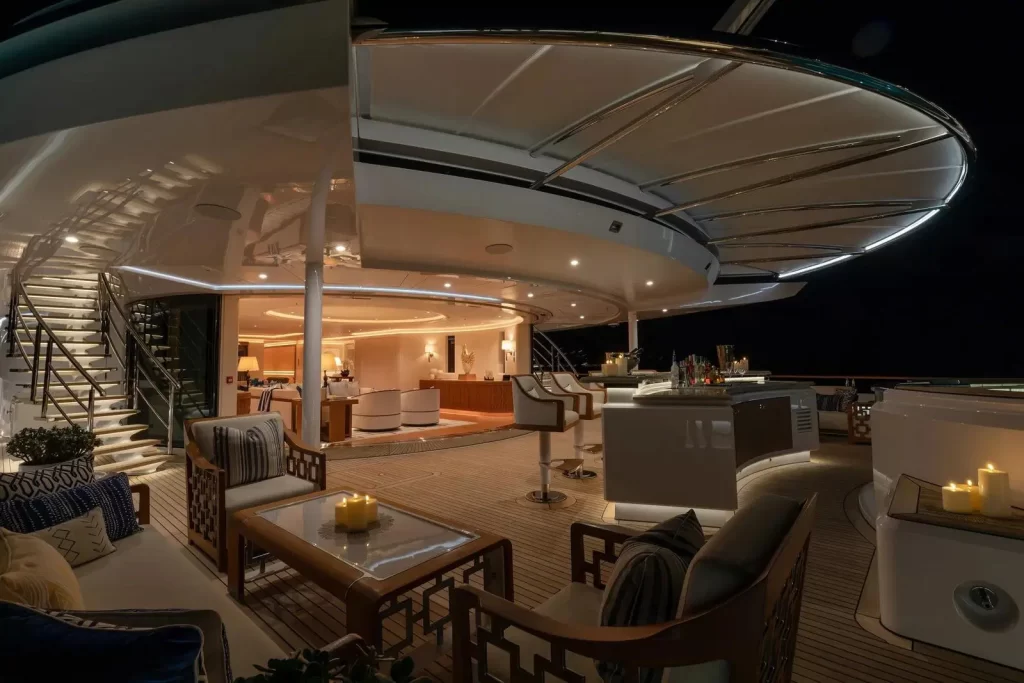
The luxuries of Samsara include a master suite with direct access to a private whirlpool deck, a cinema room ideal for revisiting the Harry Potter films, a spa complex with sauna and massage rooms, and a circular pool positioned for uninterrupted sea views. An alfresco gym provides a nod to wellness, while interiors blend contemporary elegance with the kind of comfort expected of the world’s most exclusive yachts. What was once the warmth of Edinburgh cafés has been replaced by a floating world of indulgence and privacy.
Wealth, Philanthropy, and the Arc of Legacy
Though Rowling’s lifestyle has become emblematic of literary wealth at its highest extreme, she has also sought to redefine how that wealth is used. Over the past two decades, she has donated more than $200 million to charitable causes, particularly through her foundation Lumos, which advocates for children worldwide. She has also supported medical research, poverty relief, and a host of community initiatives, demonstrating a commitment to philanthropy that parallels her commercial success.
Her ascent has not erased the memory of those lean years. In interviews and speeches, Rowling has often described the role of failure in shaping her resilience. At Harvard’s 2008 commencement, she reflected that “rock bottom became the solid foundation on which I rebuilt my life.” That philosophy still informs the way her story is told, a narrative not only of extraordinary wealth but also of the persistence that allowed her to transform rejection into global acclaim.

The contrast between her beginnings and her current life at sea captures a broader truth about modern celebrity and fortune. Rowling’s journey embodies both the dream of literary success and the cultural fascination with transformation. She was once struggling with rent and childcare, and now inhabits a sphere of near-unimaginable luxury. From scribbled notes in Edinburgh cafés to evenings on the decks of Samsara, her life has become a story as compelling as the ones she imagined, an enduring reminder that fiction, while powerful, is sometimes outpaced by reality.