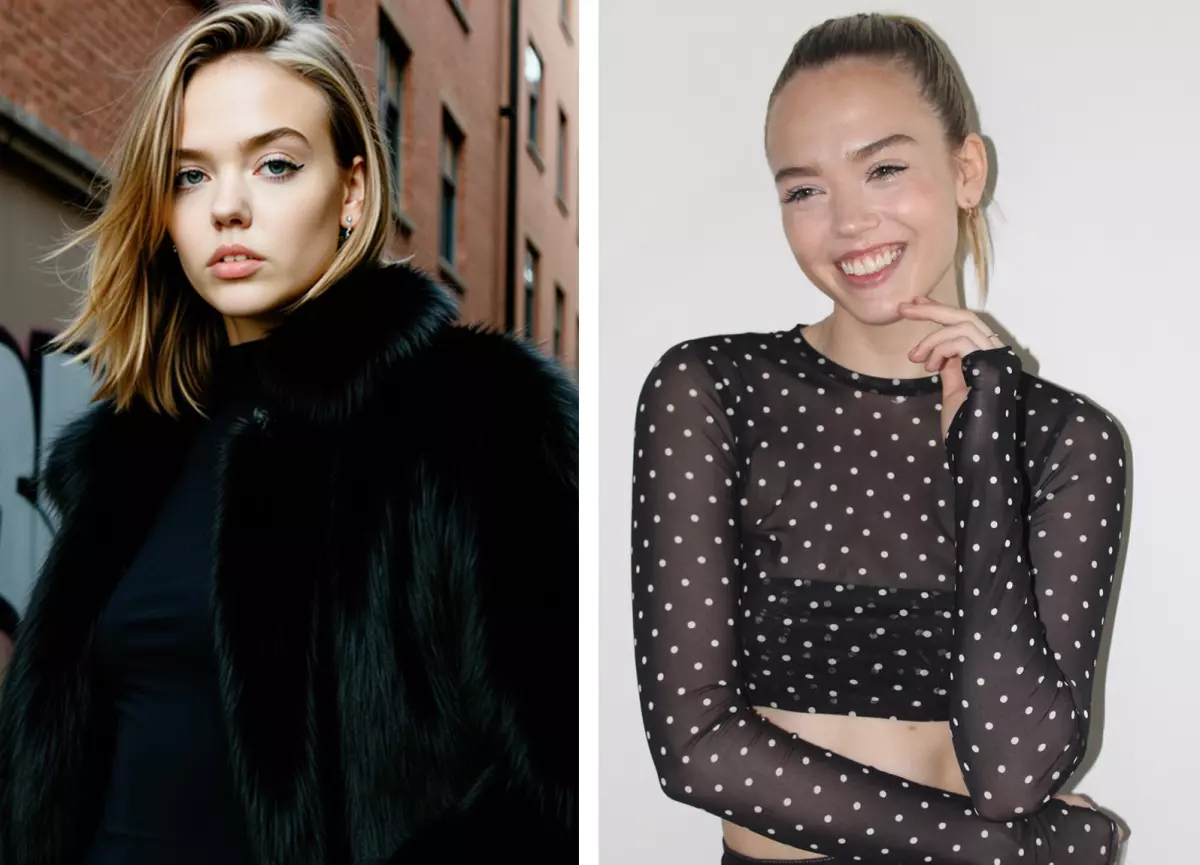
A Shifting Runway in the Age of Artificial Intelligence
In an industry long defined by beauty, charisma, and presence, the arrival of artificial intelligence is reshaping what it means to be a model. Once the sole domain of human talent, fashion campaigns now increasingly feature AI-generated avatars and digital “twins” of real models. These virtual stand-ins never grow tired, never have bad skin days, and can appear in countless locations simultaneously. For brands eager to cut costs and streamline production, the appeal is undeniable. But for working models, the new reality raises urgent questions about creativity, authenticity, and livelihood.
For 25-year-old model Hannah James, the shift from studio shoots to digital clones has been both alluring and unsettling. Based in Los Angeles, James partnered with Kartel.ai, a Beverly Hills startup that helps models create licensed digital replicas of themselves. These “clones” can be hired for advertising work, offering models new streams of income while allowing brands to avoid the expense of travel, stylists, and extended production schedules. Yet for James, as for many others, opportunity is balanced by unease. “It’s beautiful, but at the same time, it’s scary,” she admitted, reflecting on how a digital version of herself could one day diminish her own professional relevance.
Her ambivalence captures the tension coursing through the industry: a fascination with technological novelty countered by fears of erasure. As AI spreads rapidly across creative fields, models find themselves at the forefront of an experiment that could redefine fashion imagery altogether. What began as an exercise in innovation is quickly evolving into a cultural reckoning about value, visibility, and the human role in an increasingly synthetic world.
Between Opportunity and Exploitation
The tools that enable models to digitally reproduce themselves are advancing at a breakneck pace, but the standards governing their use remain fragmented. Platforms like Kartel.ai argue that licensing agreements can ensure models retain control over their likeness while being fairly compensated. In practice, however, compensation rates vary widely, and digital work often pays less than traditional shoots. While models may be able to “book” more jobs virtually, the overall earnings picture is far from settled, leaving many unsure whether cloning is truly an advantage or simply a stopgap.
Industry advocates warn of deeper risks. Sara Ziff, founder of the Model Alliance, has highlighted how technology is amplifying long-standing labor issues. Models already contend with late payments, unpredictable careers, and vulnerability to exploitation. AI threatens to add new layers of complexity by digitizing their identities without clear frameworks for consent, royalties, or protections. Without union representation, since most models are independent contractors, the balance of power remains skewed heavily toward agencies and brands.
Meanwhile, brands experimenting with AI often encounter public backlash. Guess recently drew headlines with a Vogue ad featuring a curvy AI-generated model in a floral romper, sparking criticism over the choice to invent a digital persona rather than hire a diverse human counterpart. Swedish retailer H&M has also dabbled with “digital twins” of real models, underscoring the blurred line between innovation and replacement. While these campaigns attract attention for their novelty, they also reveal consumer discomfort with an industry drifting toward the artificial at the expense of human labor.
The Uncertain Future of the Human Model
Despite the rapid advance of digital alternatives, the human element of modeling still holds irreplaceable value. Many argue that no algorithm can replicate the atmosphere of a live shoot, the interplay between photographer and model, the improvisation of movement, the energy exchanged on set. For Hannah James and her peers, this intangible “vibe” remains the heart of their work, something no line of code can generate.
Yet data from the U.S. Bureau of Labor Statistics underscores the precarious outlook. In 2024, there were roughly 5,350 modeling jobs nationwide, with 880 in California alone, concentrated in Los Angeles and its surrounding cities. Employment projections suggest little growth through 2033, in part because brands are turning to cheaper alternatives like social media influencers or reusing images, while AI opens new avenues for creating campaigns without the same reliance on physical talent. At the same time, an estimated 600 openings will continue to appear each year as models switch roles or retire, indicating that while the profession is not disappearing, it is transforming.
For some, adaptation may be the only path forward. Agencies like Otto Models in Newport Beach have voiced concern that AI avatars threaten to replace human beauty with manufactured perfection, eroding the authenticity of campaigns. Yet companies behind the technology argue their work is meant to supplement, not supplant. As Valentina Gonzalez of Seraphinne Vallora, the agency that helped create Guess’s AI campaign, explained, the goal is to “open new avenues of marketing,” not to eliminate human models entirely. The reality may be a future where human models, their digital doubles, and fully artificial creations coexist, an uneasy equilibrium that reflects both technological progress and cultural debate.