
Designed for Silence, Driven by Resilience
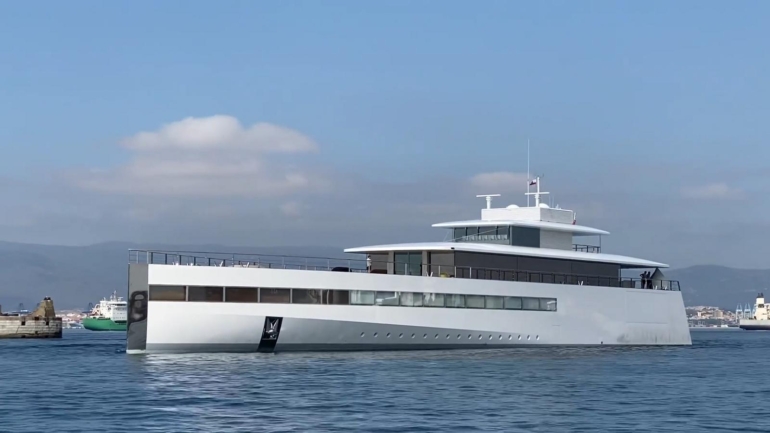
In the world of luxury yachts, few vessels have inspired more intrigue than Venus, the minimalist 78-meter superyacht commissioned by Steve Jobs before his death. Designed in collaboration with renowned French designer Philippe Starck, the vessel was not meant to flaunt extravagance. Instead, it was conceived as a sanctuary for deep thought. With its soundproofed interiors, concealed technology, and clean architectural lines, Venus was shaped to deliver one thing above all else: silence. Yet the man who commissioned it, so obsessive about quiet, was rarely still.
Jobs never set foot on the finished yacht. He passed away in 2011, and Venus was completed the following year. Today, maintained in private use by his widow, Laurene Powell Jobs, the vessel represents more than just wealth. It stands as a kind of architectural biography, an object that reflects the intensity, precision, and paradox of its owner. He didn’t need to sail on it to leave fingerprints on every surface. It was built as an extension of his working mind: ordered, quiet, but never truly at rest.
That restlessness touched every part of his life. When Jobs went on vacation, it wasn’t a break in the traditional sense. According to Tony Fadell, former Apple executive and father of the iPod, Jobs would routinely call team members up to six times a day while away. These weren’t casual check-ins. They were bursts of energy, creative interrogation, and urgent ideation. Whether he was at a lake house, on a beach, or traveling abroad, his mind stayed tethered to Cupertino. In many ways, Venus would have been the perfect setting for this paradox. It was a silent vessel built for a voice that refused to be quiet.
The Ring That Meant Everything and Nothing
For those who worked under him, a call from Steve Jobs during his “vacation” wasn’t unusual. It was expected. The calls could arrive early in the morning, late at night, or both. They often began with a simple idea, but rarely a small one. A new direction for a product. A reimagined interface. A question about acquiring a company. “You’d think he’d be resting,” said Fadell on The Tim Ferriss Show, “but he used that time to think more clearly. And then he’d call.” Those calls, Fadell added, had the power to completely change the course of a product.
Over time, Apple’s leadership came to recognize the pattern. The quiet that followed Jobs into vacation was never comforting. In fact, it often meant the opposite. It suggested that he was thinking deeply, somewhere remote, where the usual workplace noise had given way to uninterrupted focus. From that place, wherever it was, the sound of a ringing phone would inevitably follow. It wasn’t the call itself that people dreaded. It was the certainty that something fundamental was about to be questioned, reimagined, or rebuilt. For Jobs, stepping away was not about pausing. It was about reigniting.
This was how he worked. Detachment, for him, was not a retreat. It was a method. In that sense, Venus was not a missed experience. It was a culmination. Its expansive decks, hidden balconies, and noise-canceling design were not indulgences. They were instruments. Had he lived to use them, the calls would still have come. The yacht would not have silenced him. It would have given his thoughts more space to travel.
A Vessel of Vision, Anchored in Absence
The story of Venus is shaped as much by what it contains as by what it never held. Jobs had clear plans for its layout. His own quarters were to be at the stern, while his children’s cabins were positioned at the bow. In between them was silence. A long corridor, a discreet communication system, and a purposeful buffer filled the space. Like his best products, the design was intuitive and exact. Jobs wasn’t simply looking for quiet. He wanted the kind of silence that encourages deep thought and invention.
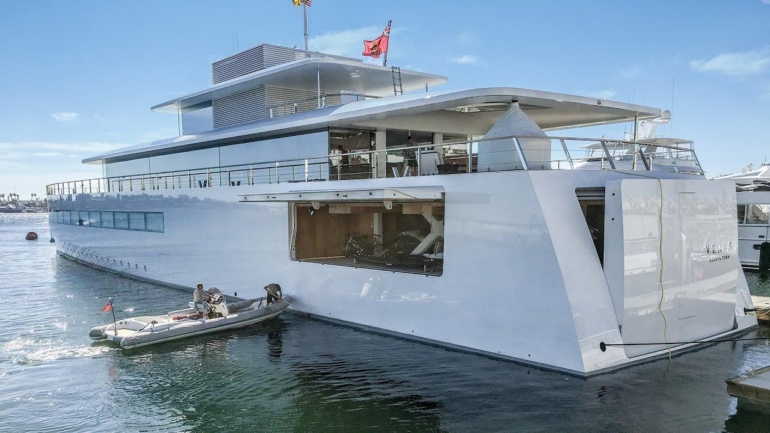
This obsession with stillness carried into other parts of his life. At his home in Palo Alto, Starck remembered the atmosphere as almost unnaturally quiet. The children didn’t shout. The dog didn’t bark. Even during the global launch of the iPhone 3G, a day marked by celebration worldwide, the house stayed calm. That same sense of focus and quiet was intended for Venus. The yacht’s navigation bridge replaced traditional controls with a clean row of iMacs. Everything was digital and frictionless, with no ambient sound.
Jobs never boarded his dream vessel. He died just months before it was ready. Today, Venus moves quietly through the Mediterranean, often spotted near Majorca or Antibes. It is a study in restraint. Its interior has never been shown to the public. There are no press tours or walkthroughs. Only the silhouette remains: sleek, silent, and untouched. But those who knew Jobs can still picture the world it was built for. It was a place where he might wake at sea, call Cupertino before breakfast, and lose himself so deeply in a problem that the quiet around him felt less like peace and more like fuel.